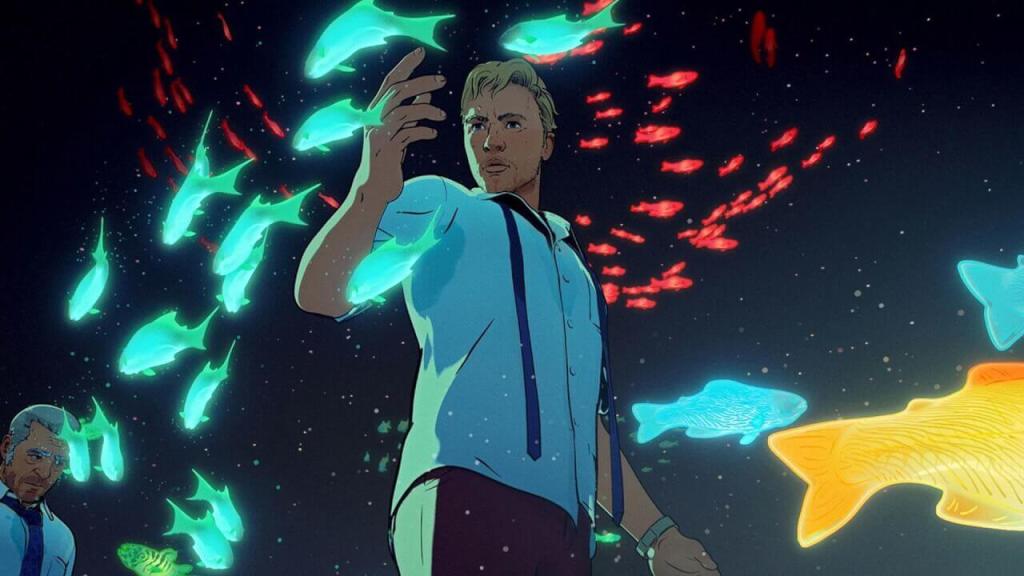
If you have yet to see Netflix’s Love Death + Robots created by Tim Miller and David Fincher then you are missing out on some brilliant storytelling. The show is an anthology of eighteen animated short stories, and while most were a hit with fans, the twelfth episode left mixed reviews. In contrast to the thrilling action and violence of the other episodes, “Fish Night” left some viewers feeling underwhelmed. One viewer on Reddit even wrote, “probably my least favourite episode so far. It just ended so abruptly and didn’t seem to have any meaning behind it”. Many others seemed to feel the same, but I was convinced otherwise. After watching it for the first time I was compelled to watch it a second, third, and even fourth time to fully try to understand the deep meaning behind the short plot. Adapted from Joe R. Lansdale’s short story in which the episode got its name, “Fish Night” is a beautifully animated film with meaning hidden deep inside the characters’ dialogue and actions. If you haven’t seen it yet, spoilers ahead.
In the beginning scene, both men get out of their car after it breaks down on the side of the desert road. Here, the old man tells the young man that the car is “dead, son. There’s no coming back from dead.” This phrase turns out to be quite ironic considering the end of the story when ancient creatures of the sea seemingly come back to life. Perhaps the old man was wrong, then. There is a way to come back from the dead as even the dead car comes back to life when the fish appear, and like the young man demonstrates, there’s even a way to go back in time to swim with the dead. This ultimately ends in tragedy, however, when a megalodon swims by and kills the young man. Although there is a way to come back from the dead, perhaps the real idea is that nothing should come back from the dead. In other words, what’s dead should stay dead.
Before going to sleep, the old man seems to lament and even fantasize about the past. He says, “The days of the door-to-door salesmen are fadin’ fast” meaning at some point he was successful in sales but is now struggling. His younger companion stays optimistic about the future of door-to-door sales saying, “It’s all about the attitude”, but the old man doesn’t seem to share the same spirit. Additionally, while talking about the ancient creatures once living in this now barren desert, he says, “It must have been nice back then. Just swimming around without a care in the world.” With these pieces of dialogue, the audience has a better understanding of the old man and his desires. When the past finally does catch up to the two men with the apparitions of the fish, the old man is seen admiring the scene as an observer while the young man decides he wants to become part of the scene. Not only does he interact with the fish by first spooking them, he decides to swim with them which symbolically allows him to go back in time. To go back in time and swim around with these creatures was the old man’s dream, but he decides not to follow his companion into this ancient world and that ultimately saves his life. It can be assumed that the young man’s naivety and inexperience led him to his doom much like Icarus flying too close to the sun in the famous Greek myth. Although the old man fantasizes about going back in time when things seemed easier, after this strange night he realizes life has never been easy. He assumed life for a fish in the ocean was “without a care in the world”, but he conveniently forgot about the dangers lurking in the darkness.
This glorification of the past is a very common response for people when problems arise in the present. For example, I was having a conversation with my friend when she exclaimed how much she wished she lived in the 50’s as opposed to today. When I inquired further, she explained that meeting a gentleman back then was easier and they actually treated women with respect, but did they really? It seems as if this friend of mine overlooked the blatant racism and sexism that plagued the 1950s. Did my single female friend not realize that had she lived in the 1950s she would have been denied access to her own line of credit? Or denied access to birth control? Or how common domestic violence was? Not to mention Black individuals were still fighting for their right to vote. My friend was apparently blind to these facts, only ever remembering the bliss and carefree nature of the decade. This fascination the human mind has on the past has even been used by politicians to gain supporters with the promise of somehow going back to those “blissful” times. The best example of this is Donald Trump’s 2016 campaign slogan “Make America Great Again”. Exactly when was America great, though? When was America exempt of any problems? The truth is, the U.S. has never been great for all its citizens. This strategy of appealing to people’s sense of false nostalgia actually worked and led to Trump’s presidency. This just proves how universal and powerful this desire to go back in time truly is, so much so that we tend to forget the consequences of the past. We all want to go back in time and swim blissfully with the fish, but we don’t want to think about the megalodons lurking in the dark.
 TeedleBear Stories
Beautiful! What a beautiful analysis! I just watch ‘Fish Night’ just now – with my two young children aged 4 and 6 no less. I gave them as much gentle context and we all really loved the imagery, the wonder….
Like you I was struck by the Icarus myth reference and while I can’t claim to have absorbed the spoken words as well as you have, it was an effective means of telling us about two humans in such a short piece. Thank you for sharing your views on this striking episode.
LikeLike
Pardon, I just ‘watched’ Fish Night, I meant to say.
LikeLike
Loved this analysis and the theme of glorifying the past! I didn’t see the nuances to it before but this article highlighted some interesting aspects of the film and made this theme make sense. Glad to see that this slightly underrated episode is getting some much-needed recognition!
LikeLike